Read the full article to gain deeper insights and comprehensive information.

Apr 28, 2026
0
India's detergent market is Rs 41,000 crore and still growing. Learn how to start a detergent powder manufacturing business in Bihar with real investment, machine costs & profit data.
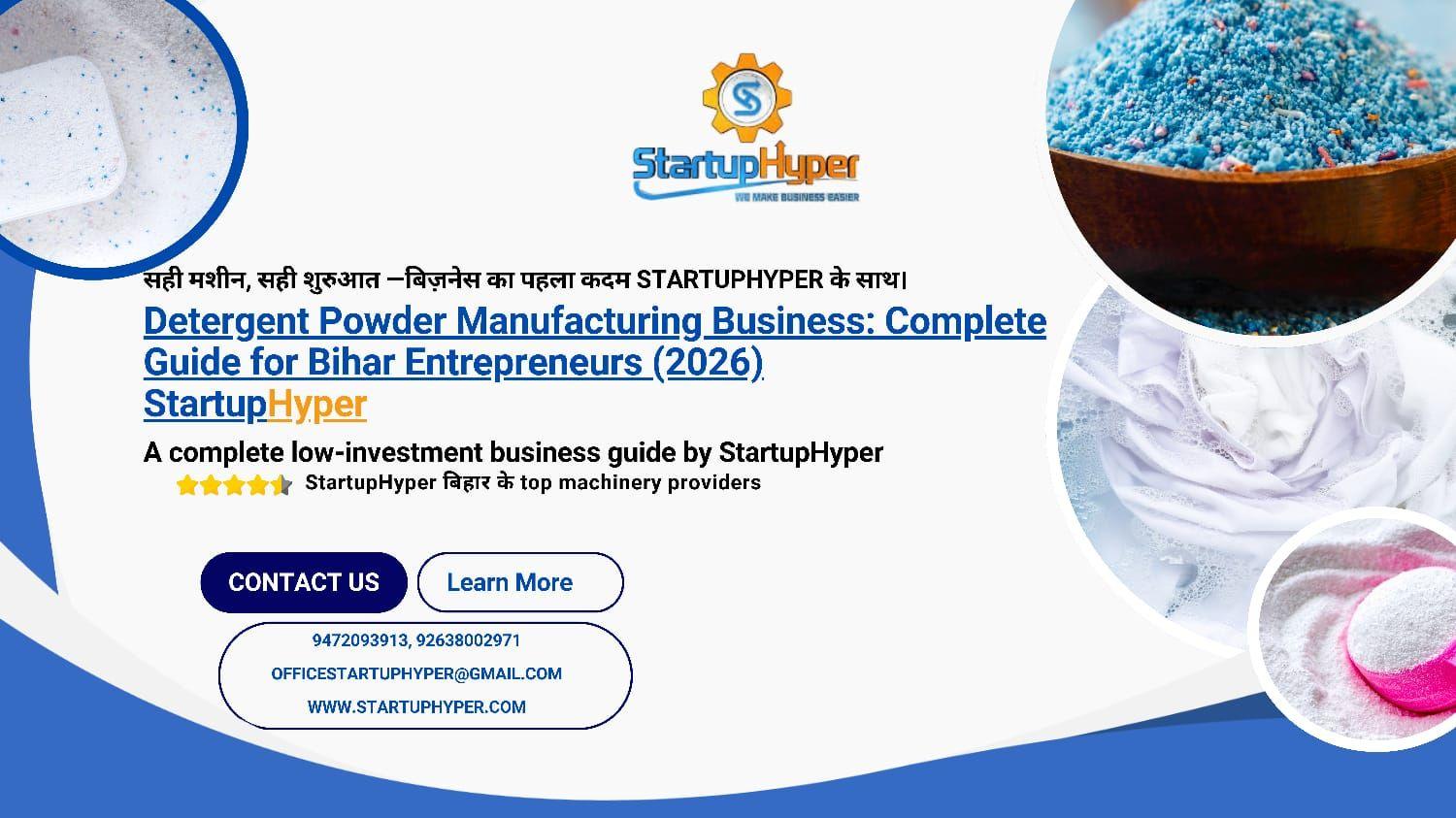
Walk into any home in Bihar — urban, semi-urban, or rural — and you will find one product without exception. Not a smartphone. Not a branded snack. A packet of washing powder.
India's per capita detergent consumption is 2.7 kg per year and rising. The country's laundry detergent market was valued at $5 billion in 2025 and is projected to reach $7.6 billion by 2034. Powder detergent alone commands 48.5% of that market — the largest segment — because it works for both hand washing and machine washing, and it fits every price point from Rs 10 sachets to Rs 500 premium packs.
Eastern India still relies heavily on low-cost regional detergent brands and unorganized local products. Price sensitivity is high, brand loyalty is low, and a locally manufactured washing powder priced competitively against Ghadi, Nirma, and Wheel has a genuine opening — especially in smaller towns, wholesale grain markets, and rural retail networks where national brand supply chains are inconsistent.
This guide gives you everything you need to start — machine types, investment breakdown, raw material sourcing, step-by-step setup, real profit numbers, and how Startuphyper supports you through the entire process.
This is not a small market. It is one of the largest FMCG categories in the country — with consistent daily demand from every household, hotel, hospital, factory, and institution in India.
| Market Metric | Data (2025–2026) |
|---|---|
| India laundry detergent market size | $5.00 Billion (2025) |
| Projected size by 2034 | $7.60 Billion |
| CAGR (2026–2034) | 4.13% |
| Powder detergent market share | 48.5% of total India market |
| India FMCG detergent market (all segments) | ₹41,000+ crore annually |
| India per capita detergent use | 2.7 kg/year (vs. 10 kg in USA) |
| Washing machine penetration in India | 13% of households — still growing |
| Unorganized market share | 35%+ in semi-urban and rural Bihar |
| India detergent market CAGR (broader) | 7.9% (2025–2031, 6Wresearch) |
Bihar-Specific Insight
Eastern India accounts for a disproportionately large share of India's unorganized detergent market. Branded national players — HUL, P&G, Nirma, Ghadi — dominate urban Patna. But in Darbhanga, Siwan, Bettiah, Samastipur, Araria, and hundreds of smaller towns, the market is still held by regional and contract-manufactured products. A locally produced, decently packaged, competitively priced washing powder can directly compete and win in this geography.
Detergent powder manufacturing is the process of blending chemical raw materials — surfactants, builders, fillers, and additives — into a free-flowing powder that removes dirt, oil, and stains from fabric when dissolved in water.
Unlike food processing or agarbatti manufacturing, detergent powder production does not require heat, fire, or complex machinery. The core process is cold mixing — combining pre-weighed chemical ingredients in a ribbon blender or paddle mixer, sieving the output for uniform particle size, then packaging. No furnace. No boiling. No drying. Just mixing, sieving, and packing.
This makes it one of the lowest-complexity manufacturing processes available to a first-time MSME entrepreneur. A team of 3 people with one mixer machine and basic raw material can produce 200-500 kg of finished washing powder per day from Day one.
Products you can manufacture from the same setup:
• Laundry / washing powder (primary product)
• Dishwash powder
• Floor cleaning powder
• Fabric whitener powder
• Industrial cleaning powder (hotels, hospitals, factories)
One machine. One setup. Five product lines. This versatility is a major competitive advantage over businesses like agarbatti or paper bags, where each product category requires a different machine.
Detergent powder manufacturing requires 3 core machines. You cannot skip any of them.
Machine 1 — Ribbon Blender / Powder Mixer
This is the heart of your manufacturing unit. The ribbon blender is a U-shaped horizontal mixing drum with inner and outer spiral ribbons that move material in opposite directions, producing uniform blending of all chemical ingredients in a single batch.
| Machine Capacity | Batch Size | Price Range | Best For |
|---|---|---|---|
| 50–100 kg batch | 50–100 kg/batch | ₹45,000 – ₹80,000 | Home-based / micro unit |
| 200–300 kg batch | 200–300 kg/batch | ₹80,000 – ₹1,50,000 | Small manufacturing unit |
| 500–1,000 kg | 500–1,000 kg/batch | ₹1,50,000 – ₹3,50,000 | Commercial unit |
How many batches per day: A 200 kg batch mixer completes one batch in 20-30 minutes. Running 6-8 batches per shift gives 1,200-1,600 kg of finished powder per day.
Machine 2 — Cage Mill / Sieving Machine
After mixing, the blended powder passes through a cage mill or vibrating sieve to break up any lumps and ensure uniform particle size. This is non-negotiable — lumpy washing powder returns and complaints will destroy your reputation with distributors.
| Machine Type | Purpose | Price Range |
|---|---|---|
| Cage Mill (Disintegrator) | Breaks lumps, creates free-flowing powder | ₹35,000 – ₹85,000 |
| Vibrating Sieve Machine | Removes oversized particles, ensures uniform grade | ₹20,000 – ₹50,000 |
Machine 3 — Packing Machine
Finished detergent powder needs to be weighed and packed into pouches or cartons accurately. A semi-automatic packing machine is essential from Day 1.
| Machine Type | Output | Price Range |
|---|---|---|
| Manual Weighing + Hand Sealer | 100–200 packs/hr | ₹8,000 – ₹15,000 |
| Semi-Auto Pouch Packing Machine | 400–800 packs/hr | ₹55,000 – ₹1,20,000 |
| Fully Auto Packing Machine | 1,000–3,000 packs/hr | ₹1,50,000 – ₹2,50,000 |
Complete Machine Setup Cost
Ribbon blender (200 kg) + cage mill + semi-auto packing machine = Rs 1.70-Rs 3.55 lakh. This gives you a complete production line capable of making 800-1,200 kg of finished washing powder per day.
| Item | Cost (Approx.) |
|---|---|
| Ribbon Blender (50–100 kg batch) | ₹45,000 – ₹75,000 |
| Cage Mill / Sieve | ₹25,000 – ₹35,000 |
| Manual Weighing + Hand Sealer | ₹10,000 – ₹15,000 |
| Raw Material (1 month) | ₹25,000 – ₹35,000 |
| Packaging (pouches + labels) | ₹8,000 |
| Miscellaneous / tools | ₹5,000 |
| TOTAL | ₹1.18 – ₹1.73 Lakh |
| Item | Cost (Approx.) |
|---|---|
| Ribbon Blender (200–300 kg batch) | ₹90,000 – ₹1,50,000 |
| Cage Mill | ₹50,000 – ₹85,000 |
| Semi-Auto Pouch Packing Machine | ₹65,000 – ₹1,20,000 |
| Raw Material (2 months stock) | ₹60,000 – ₹80,000 |
| Workshop / Shed Setup | ₹25,000 – ₹40,000 |
| Packaging Design + Labels | ₹15,000 |
| Licenses + Registration | ₹10,000 – ₹15,000 |
| Working Capital Buffer | ₹25,000 |
| TOTAL | ₹3.40 – ₹5.10 Lakh |
| Item | Cost (Approx.) |
|---|---|
| Ribbon Blender (500–1,000 kg batch) | ₹2 – ₹3.5 Lakh |
| Cage Mill + Screw Conveyor + Sieving | ₹1.5 – ₹2.5 Lakh |
| Fully Auto Packing Line | ₹2 – ₹4 Lakh |
| Factory Space Setup | ₹1 – ₹2 Lakh |
| Raw Material (3 months bulk) | ₹2 – ₹4 Lakh |
| Branding, Website, Samples | ₹50,000 |
| Licenses + GST + Pollution NOC | ₹25,000 |
| Contingency (10%) | ₹1 – ₹1.5 Lakh |
| TOTAL | ₹10.25 – ₹17.75 Lakh |
Government Funding Available
Under MMUY (Bihar), entrepreneurs can get up to Rs 10 lakh with 50% subsidy and 0% interest. Under PMEGP (national), manufacturing units can get up to Rs 25 lakh with 15-35% subsidy. Detergent manufacturing is listed in KVIC's approved project profiles — directly eligible. Startuphyper prepares your DPR and handles the full application.
Detergent powder has 6-8 chemical ingredients. All are available from chemical wholesale traders in Patna, Kanpur, and through online bulk platforms.
| Raw Material | Role in Detergent | Price/kg | Availability |
|---|---|---|---|
| LABSA (Acid Slurry) | Primary surfactant — core cleaning agent | ₹75 – ₹95/kg | Chemical traders (Patna / Kanpur) |
| Soda Ash Light | Alkaline builder — softens water, boosts cleaning | ₹42 – ₹46/kg | Widely available chemical wholesalers |
| Sodium Silicate | Binder, anti-corrosion, improves powder flow | ₹25 – ₹35/kg | Chemical suppliers |
| Sodium Sulphate | Filler — adds body and weight to the powder | ₹10 – ₹16/kg | Chemical wholesale markets |
| STPP (Sodium Tripolyphosphate) | Water softener, prevents soil re-deposition | ₹55 – ₹75/kg | Chemical traders |
| Optical Brightener (OBA/CBS) | Makes clothes appear whiter under UV light | ₹800 – ₹1,800/kg | Used in very small quantity (0.1–0.3%) |
| Fragrance / Perfume | Gives the powder its scent | ₹200 – ₹600/kg | Fragrance traders |
| Color Speckles | Visual appeal — colored flecks in powder | ₹80 – ₹120/kg | Specialty chemical suppliers |
Standard economy-grade washing powder formulation for 1 kg:
• LABSA: 12% = 120g x Rs 85/kg = Rs 10.20
• Soda Ash: 25% = 250g x Rs 44/kg = Rs 11.00
• Sodium Sulphate: 40% = 400g x Rs 13/kg = Rs 5.20
• Sodium Silicate: 8% = 80g x Rs 30/kg = Rs 2.40
• STPP: 8% = 80g x Rs 65/kg = Rs 5.20
• Fragrance + Brightener + Speckles: 7% = Rs 4-6
• Total raw material cost per kg: Rs 38-40
• Add electricity + labour + packaging: Rs 12-18/kg
• Total production cost per kg: Rs 50-58
• Wholesale selling price: Rs 70-100/kg
• Retail selling price: Rs 110-160/kg
• Profit margin: Rs 12-42/kg depending on channel
This is why detergent powder is one of the simplest manufacturing businesses to run. The entire process is cold — no heat, no flames, no boiling.
1. Weigh All Raw Materials — Measure each chemical ingredient precisely using a digital scale. Accuracy here determines product quality.
2. Load Mixer — Pour all dry ingredients first. Then slowly pour LABSA in thin streams while the mixer runs. Adding LABSA too fast creates clumps.
3. Mix for 15-20 Minutes — Run the ribbon blender until the powder is uniform and free-flowing. Add fragrance and optical brightener in the final 5 minutes.
4. Pass Through Cage Mill / Sieve — Break residual lumps and ensure uniform particle size through a 40-60 mesh vibrating sieve.
5. Pack and Label — Feed sieved powder into the packing machine. Pack in 500g, 1 kg, or 5 kg pouches. Apply branded labels with batch number, manufacturing date, and MRP.
Total batch time for 200 kg: approximately 45-60 minutes including loading, mixing, sieving, and packing.
Do not start by competing with Surf Excel or Ariel. Position yourself in one of three viable segments:
• Economy / Budget — compete with Nirma and Ghadi on price; sell at Rs 70-85/kg wholesale to rural kirana stores
• Mid-Range — better formula and fragrance; sell at Rs 100-120/kg to supermarkets and distributors
• Institutional — bulk 25 kg or 50 kg packs to hotels, hospitals, schools at Rs 60-75/kg with high volume
• Udyam (MSME) Registration — free, online
• GST Registration — detergent powder (HSN 3402) attracts 18% GST; factor into pricing from Day 1
• BIS Certification (IS 4955) — not mandatory for small units, but needed for organized retail
• Trade License from local municipality
• Pollution NOC from Bihar State Pollution Control Board (Orange category)
Contact Startuphyper for chemical raw material linkage in Patna and nearby districts. Bulk procurement from Kanpur or Ahmedabad reduces raw material cost by 10-15% compared to local retail rates. Minimum space requirement: 400-600 sq ft.
Run 5-10 test batches before launching commercially. Test on cotton, synthetic, and coloured fabrics. Check lather quality in hard water, rinse cleanliness, fragrance duration, and powder flow. Refine the formula before approaching any distributor.
• Wholesale distributors in Patna (Chowk), Gaya, Muzaffarpur, Bhagalpur
• Institutional buyers — hotels, hospitals, railway contractors, school hostels
• Kirana stores via direct supply with 2-week credit and free first sample
• IndiaMART listing for B2B leads from across Bihar and Eastern India
• Government tender supply to BSNL, railways, municipal bodies, hospitals
Monthly profit model for a small detergent powder unit in Bihar with one 200 kg batch mixer.
| Parameter | Details |
|---|---|
| Machine | 1 Ribbon Blender (200 kg batch) |
| Batches per day | 6 batches |
| Daily production | 1,200 kg |
| Working days per month | 26 days |
| Monthly production | 31,200 kg |
| Raw material + production cost per kg | ₹55 |
| Total monthly production cost | ₹17,16,000 |
| Labour — 3 workers | ₹22,000 |
| Electricity + misc | ₹12,000 |
| Packaging (pouches + labels + cartons) | ₹62,000 |
| Total monthly expenses | ₹18,12,000 |
| Selling price (wholesale average) | ₹80/kg |
| Monthly revenue | ₹24,96,000 |
| Net monthly profit | ~₹6,84,000 |
Note on Scale
These numbers are for a 1,200 kg/day unit at full capacity. In the first 2-3 months, operate at 30-40% capacity while building distribution. Realistic Month 1-2 net profit: Rs 1.5-2.5 lakh. Month 3-4 onwards: Rs 3-5 lakh/month.
Profit by Sales Channel
| Channel | Selling Price | Margin per kg |
|---|---|---|
| Institutional (bulk 25 kg packs) | ₹65 – ₹75/kg | ₹10 – ₹20/kg |
| Wholesale distributor | ₹78 – ₹90/kg | ₹23 – ₹35/kg |
| Retail (own brand, kirana direct) | ₹110 – ₹140/kg | ₹55 – ₹85/kg |
ROI Timeline: For a Rs 3-5 lakh investment (Scenario B), with realistic Month 3 net profit of Rs 2-3 lakh, break-even falls at 2-3 months — one of the fastest ROI cycles in MSME manufacturing.
| Customer Type | Product Needed | Volume/Month | How to Approach |
|---|---|---|---|
| Kirana / General Stores | 500g, 1 kg retail packs | 50–200 kg/store | Direct visit + free sample + 15-day credit |
| Wholesale Distributors | 5 kg, 10 kg bulk packs | 500–5,000 kg | Meeting + price list + sample case |
| Hotels and Guest Houses | 5 kg / 25 kg bulk packs | 100–1,000 kg | Direct pitch to purchase manager |
| Hospitals and Clinics | 25 kg bulk institutional | 200–2,000 kg | Tender / direct procurement |
| Railway Canteens / Contractors | Bulk supply | High | Government procurement / tender |
| Laundries and Dhobi Ghats | 25–50 kg sacks | 500–3,000 kg | Direct approach; very price-sensitive |
| Schools / College Hostels | 25 kg institutional | 200–1,000 kg | Procurement through principal / warden |
Week 1 Action Plan : Identify 5 wholesale distributors in your district. Offer free 5 kg samples with a price list. Visit 20 kirana stores. Drop 500g sample packs. Follow up after 3 days. Close your first bulk order before the end of Week 2.
| License / Registration | Authority | Requirement | Cost |
|---|---|---|---|
| Udyam (MSME) Registration | Ministry of MSME | Recommended for all units | Free |
| GST Registration | GST Council | Mandatory above ₹20L turnover | Free |
| Trade License | Municipal Corporation | Required to operate commercially | ₹500 – ₹3,000 |
| Factory License | Bihar Labour Dept. | 10+ workers with powered machines | ₹2,000 – ₹8,000 |
| Pollution Control NOC | Bihar SPCB | Orange category industry | ₹2,000 – ₹8,000 |
| BIS Certification (IS 4955) | Bureau of Indian Standards | Recommended for organized retail | ₹15,000 – ₹40,000 |
| Fire Safety Certificate | Bihar Fire Dept. | Required (chemicals are flammable) | ₹500 – ₹2,000 |
GST Note: Detergent powder falls under HSN Code 3402 and attracts 18% GST — the standard rate for cleaning products. Plan your pricing and invoicing structure accordingly from Day 1.
Mistake 1 — Copying a formula without adjusting for local water hardness
Bihar's water supply is moderately to highly hard in many districts. A formula designed for soft-water regions may produce poor lather and leave white residue on clothes. Before finalizing your formula, test it in the actual water quality of your target market. Increase STPP percentage for high-hardness districts like Gaya, Nalanda, and Jehanabad.
Mistake 2 — Launching a retail brand before building production consistency
Run 10 consistent batches with no quality variation before putting your brand name on a single pouch. If your first batch is lumpy, leaves a chemical smell, or doesn't clean well, you permanently lose those first customers.
Mistake 3 — Underestimating the LABSA handling requirement
LABSA (acid slurry) is corrosive. Always add it slowly in a thin stream while the mixer is already running. Store in acid-resistant HDPE drums, not metal containers. Handle with gloves and eye protection.
Mistake 4 — Pricing without factoring in 18% GST
If you price at Rs 80/kg and forget to account for GST in your invoice, your actual realized margin collapses. Every B2B buyer will ask for a GST-inclusive invoice. Get GST registration done before your first bulk sale.

| What We Do | Details |
|---|---|
| Machine Sourcing | Verified ribbon blenders, cage mills, packing machines from Indore, Pune, Ahmedabad — delivered to Bihar |
| Installation & Training | On-site machine setup + operator training at your location |
| Formula Support | Basic detergent powder formulation guidance for economy, mid-range, and institutional grades |
| Project Report (DPR) | Complete DPR for MMUY / PMEGP / bank loan applications |
| License Support | Udyam, GST, Trade License, Pollution NOC — paperwork handled |
| Government Scheme Guidance | MMUY, PMEGP, Stand-Up India — eligibility check + application support |
| Raw Material Linkage | LABSA, soda ash, STPP, fragrance — verified suppliers in Patna and Kanpur |
| Branding + Packaging | Pouch design, label printing, brand name suggestions |
| Market Linkage | Introduction to wholesale distributors and institutional buyers in Bihar |
We have supported 500+ startups across 60+ business categories in Bihar and Eastern India.
Q1. How much investment is needed to start a detergent powder business in Bihar?
A micro home-based unit costs Rs 1.18-1.73 lakh. A proper small manufacturing unit with 200 kg batch mixer, cage mill, semi-auto packing machine, shed, and raw material costs Rs 3.40-5.10 lakh. Government schemes like MMUY (50% subsidy) and PMEGP (up to 35% subsidy) can significantly reduce your actual out-of-pocket investment.
Q2. What is the GST rate on detergent powder?
Detergent powder falls under HSN Code 3402 and attracts 18% GST. This applies both to the finished product you sell and to certain raw materials you purchase (where you can claim input tax credit after GST registration).
Q3. Do I need BIS certification to sell detergent powder in India?
BIS certification (IS 4955) is not mandatory for all small-scale manufacturers selling locally. Organized retail chains and government procurement typically require it. If your target market is kirana stores, wholesale distributors, and institutions, you can start without BIS and add certification in Phase 2.
Q4. How do I compete with Nirma, Ghadi, and national brands?
You do not compete with them directly — you compete for the market they do not effectively serve. National brands focus on urban Patna and tier-2 towns. A local manufacturer who offers 15-day credit, consistent supply, responsive service, and competitive pricing has a real advantage in the 200+ small towns and 45,000+ villages of Bihar that national brands underserve.
Q5. Can I make liquid detergent on the same machine?
No. Liquid detergent manufacturing requires a different mixing setup — stainless steel liquid mixing tank with agitator, dosing pumps, and a liquid filling line. However, the raw material storage, workspace, and distribution network you build for powder can be shared when you add a liquid line in Phase 2.
Q6. Is detergent powder manufacturing safe to run from home?
A small-scale unit can be home-based but requires a separate, well-ventilated room or shed. LABSA is mildly corrosive and should not be handled near food, children, or open flames. The Bihar SPCB classifies detergent manufacturing as Orange category — moderate risk — meaning you will need a Pollution NOC even for small units.
The detergent powder business sits at a rare intersection: large market, simple manufacturing process, fast ROI, and a clear opportunity in Bihar where the unorganized segment is still wide open.
India's washing powder market is Rs 41,000+ crore and growing. Per capita consumption will climb as incomes rise and washing machine adoption spreads through semi-urban Bihar. The demand is not going anywhere.
Here is what to remember:
• The process is simple — ribbon blending, sieving, and packing. No heat, no flames, no complex machinery. A 3-person team can run a production shift from Day 1.
• Start institutional, build retail — bulk supply to hotels, hospitals, and laundries gives you cash flow in Month 1. A retail brand gives you margin in Month 6.
• GST is 18% — account for it from Day 1. Every B2B customer will ask for a proper invoice. Register before your first bulk order.
Startuphyper is ready to take you from machine selection to first delivery — machine sourcing, installation, formula support, licensing, government scheme application, and market linkage.
Which product segment are you planning to start with — economy grade, institutional supply, or a retail brand? Drop your question in the comments or call our team directly. We respond within the business day.
Stay updated: subscribe to the Startuphyper newsletter at www.startuphyper.com
📞Call / WhatsApp: 9472093913
📧Email: info@startuphyper.com
🌐 Website: www.startuphyper.com | www.machinehai.com
🏢 Branches: Patna | Gaya | Katihar | Saharsa
Stay updated with the latest tips, trends, and best practices in factory setup and machinery procurement—subscribe to the StartupHyper newsletter!
No spam, we promise. Your inbox is safe with us—only valuable insights.