Read the full article to gain deeper insights and comprehensive information.

Aug 26, 2026
0
Learn how to start a sattu making business, including the manufacturing process, raw materials, machinery, investment, packaging, marketing strategies, and profit potential.

What is a Sattu Making Business?
Why Start a Sattu Making Business?
Types of Sattu Products
Sattu Making Business Manufacturing Process
Raw Materials Required for Sattu Making
Machinery Required for Sattu Manufacturing
Sattu Making Business Investment
Sattu Business Profit Margin
Marketing Strategies for Sattu Business
How to Increase Sattu Business Sales
Common Mistakes to Avoid in Sattu Business
How StartupHyper Can Help with Sattu Business
Frequently Asked Questions
Conclusion
→ To Read our full guide in Hindi: Click Here
A sattu making business is a food-processing business in which grains or pulses, mainly Bengal gram (chana), are cleaned, roasted, ground and packaged to make sattu. Sattu is a traditional Indian food product commonly used to prepare drinks, parathas, litti and other food items.
In this business, the manufacturer purchases quality raw materials, processes them using suitable machinery, and sells the finished sattu under a brand name. The product can be sold through local grocery shops, supermarkets, wholesalers, distributors and online platforms.
A sattu business can be started on a small, medium or large scale, depending on the available investment and expected production capacity. The main focus should be on maintaining consistent quality, hygienic production, proper packaging and competitive pricing.
Starting a sattu making business can be a promising opportunity for entrepreneurs because sattu is a traditional food product consumed in many parts of India. It is affordable, convenient to prepare and can be used in drinks, litti, parathas and other food items.
Sattu has regular demand among consumers who prefer traditional and convenient food products. Its popularity in different regions and increasing availability through retail and online channels can provide opportunities for new manufacturers.
The main raw materials used in sattu production, such as gram and other grains, are generally available through local agricultural markets and suppliers. Proper sourcing and bulk purchasing can help manufacturers manage their production costs.
A sattu business can be started with a small production setup and expanded gradually. Entrepreneurs can begin with limited machinery and production capacity and increase their investment as the customer base and sales grow.
Manufacturers can produce different varieties such as chana sattu, barley sattu and multigrain sattu. Offering different products allows a business to target customers with different tastes and preferences.
Sattu can be sold through local grocery stores, supermarkets, wholesalers, distributors and online platforms. Using multiple sales channels can help a new business reach more customers and increase its market presence.
A new sattu business can create its own brand through attractive packaging, a memorable brand name and consistent product quality. Good branding can help the product stand out from local competitors and build customer recognition.
Once the business develops a stable customer base, the entrepreneur can increase production capacity and introduce additional roasted grain and flour products. This can create opportunities to expand the product portfolio and reach new markets.
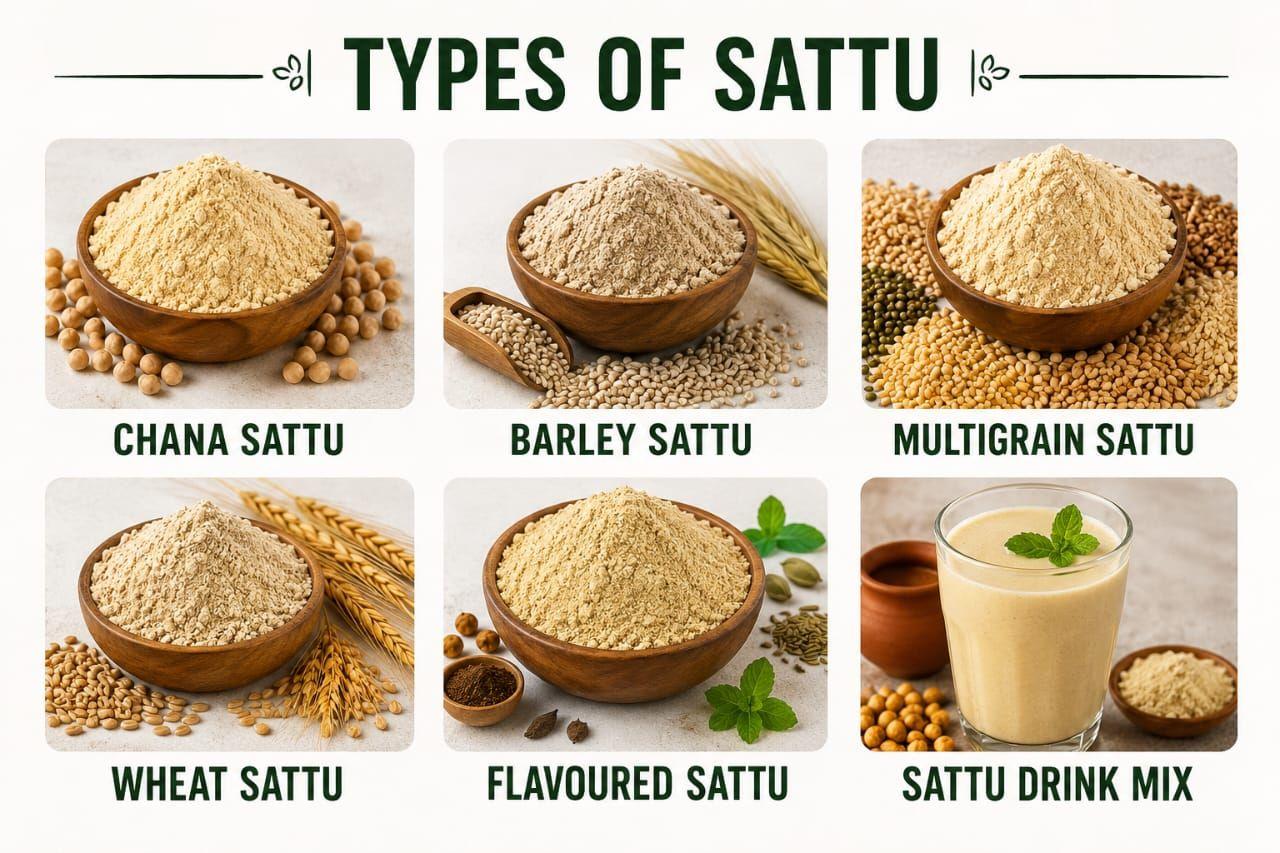
Sattu can be prepared using different grains and pulses, allowing manufacturers to offer multiple products according to customer preferences and market demand.
Chana sattu is mainly made from roasted Bengal gram and is one of the most commonly consumed varieties of sattu.
It is commonly used to prepare sattu drinks and traditional foods such as litti and parathas.
Barley sattu is made by roasting and grinding barley into a fine powder.
It can be sold as an alternative to chana sattu and used in drinks and other food preparations.
Multigrain sattu is prepared by combining different grains and pulses to create a mixed-grain product.
It can attract customers looking for variety and can be developed with different grain combinations.
Wheat sattu is produced by roasting and grinding wheat into a fine powder.
It can be used in traditional food preparations and beverages and provides another product option for manufacturers.
Flavoured sattu is prepared by adding suitable spices or other permitted ingredients to provide different taste options.
Different flavours can help manufacturers attract customers who prefer more variety in sattu products.
Sattu drink mix is formulated for convenient preparation by mixing the product with water and other suitable ingredients.
It can be offered in ready-to-use packaged formats and marketed as a convenient beverage option.
The sattu manufacturing process can be divided into the following step-by-step stages, from selecting raw materials to final packaging and distribution.
Good-quality gram, barley, wheat or other grains are selected according to the type of sattu being produced. The raw materials should be clean, dry and free from insects and unwanted materials.
The selected grains or pulses are thoroughly cleaned to remove dust, stones, husk and other impurities. Cleaning helps maintain the quality and hygiene of the final product.
The cleaned raw materials are roasted using a suitable roasting machine or controlled roasting system. Proper roasting gives sattu its characteristic taste, aroma and texture.
After roasting, the grains or pulses are allowed to cool properly before grinding. This helps prevent excess heat from affecting the grinding process.
The cooled roasted material is transferred to a pulverizer or grinding machine. It is ground into a fine and uniform powder according to the required product specification.
The ground material is passed through a sieve to remove larger particles and achieve a smooth, consistent texture.
The prepared sattu is checked for quality, including its colour, aroma, texture, cleanliness and moisture level. Any unsuitable material is removed before packaging.
The finished sattu is accurately weighed according to the selected package size, such as 200 g, 500 g or 1 kg.
The measured sattu is filled into suitable food-grade pouches or containers. The packages are properly sealed to protect the product from moisture and contamination.
The packaged product is labelled with the required product and regulatory information, such as product name, net quantity, batch details, dates and manufacturer information.
The finished packets are stored in a clean, dry and suitable storage area until they are ready for distribution.
The packaged sattu is supplied to retailers, wholesalers, distributors, supermarkets or customers through online and offline sales channels.
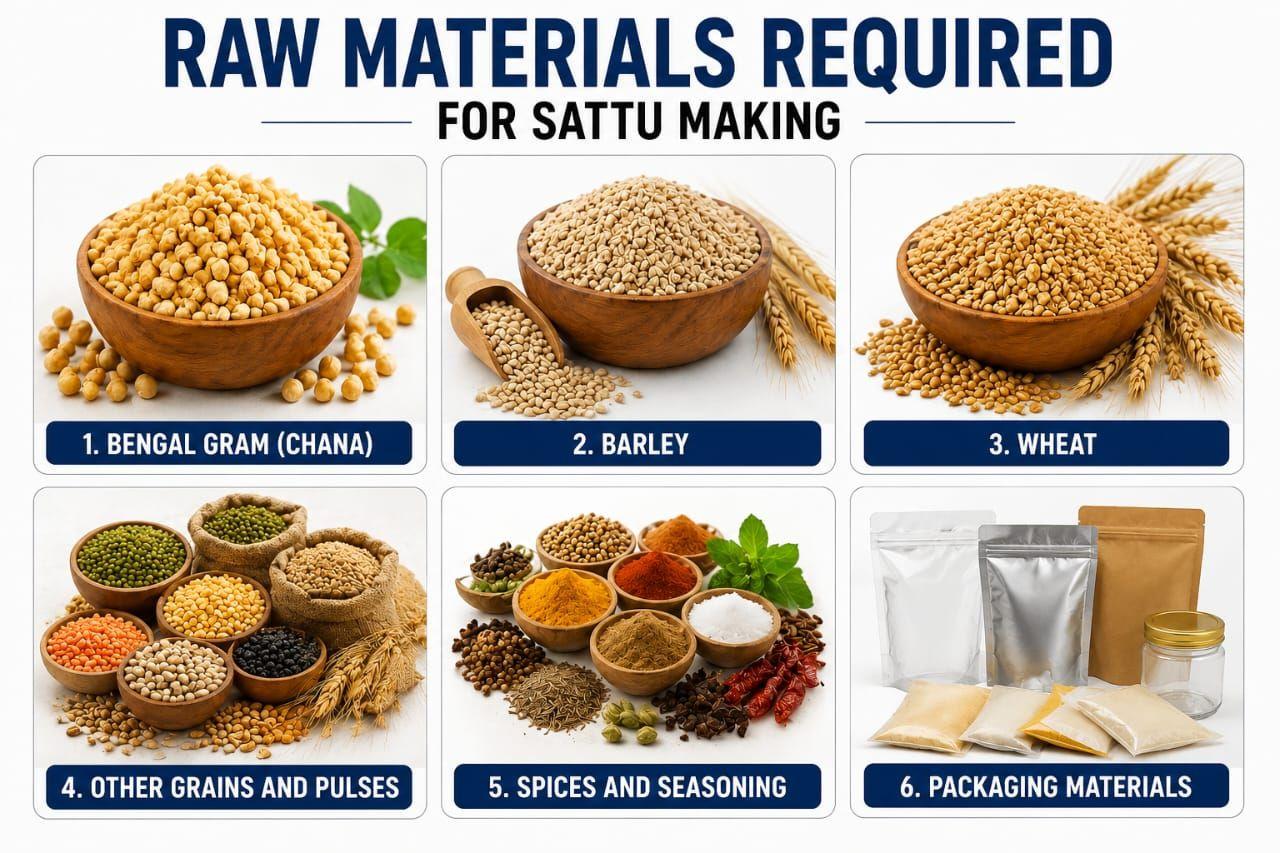
The raw materials required for sattu production depend on the type of sattu being manufactured. Good-quality raw materials are important for maintaining the taste, aroma, texture and overall quality of the finished product.
Bengal gram is one of the main raw materials used for producing chana sattu. Clean and good-quality gram is selected and roasted before grinding.
Barley is used for producing barley sattu and can also be combined with other grains for multigrain varieties. The grains should be clean and properly dried before processing.
Wheat can be used to manufacture wheat-based sattu or as an ingredient in certain multigrain formulations. Good-quality wheat helps maintain consistent product quality.
Different grains and pulses can be used to develop multigrain sattu according to the product formulation. The selected ingredients should be properly cleaned and suitable for food processing.
Salt, spices and other suitable ingredients may be used when manufacturing flavoured or ready-to-mix sattu products. The ingredients should meet applicable food safety requirements.
Food-grade pouches, containers, labels and cartons are required for packing and transporting the finished sattu. The packaging should provide suitable protection from moisture, contamination and physical damage.
The machinery required for a sattu manufacturing unit depends on the production capacity, level of automation and type of sattu being produced.
It is used to remove dust, stones, husk and other impurities from gram, grains and pulses.
It is used to roast gram, barley and other grains evenly to achieve the desired taste, aroma and colour.
It is used to cool the roasted grains before grinding and prepare them for the next processing stage.
It is used to grind roasted grains and pulses into fine sattu powder with a consistent texture.
It is used to separate larger particles and produce smooth and uniform sattu.
It is used to measure the required quantity of sattu accurately before packaging.
It is used to fill sattu into pouches or containers according to the required pack size.
It is used to seal the packages properly and protect the product from moisture and contamination.
It is used to print batch numbers, dates and other required information on the packaging.
It is used to store raw materials and finished sattu safely in a clean and organised manner.
The investment for a sattu making business depends on the business size, machinery, production capacity and location.
Machinery cost includes cleaning, roasting, grinding and packaging machines.
Raw material cost includes chana, barley, wheat, pulses and other ingredients.
Packaging cost includes pouches, labels, boxes and sealing materials.
Rent and setup cost includes the production area, electricity and basic infrastructure.
Labour cost includes wages or salaries for workers involved in production and packaging.
Marketing cost includes branding, advertising and product promotion.
Working capital is required for raw materials, electricity, transportation and other daily expenses.
A small-scale sattu business can generally be started with around ₹3 lakh to ₹8 lakh, depending on the machinery and production capacity.
The profit margin in a sattu business depends on the raw material cost, production expenses, packaging, selling price and sales volume. A proper cost calculation helps the entrepreneur understand how much profit can be earned from each kg of sattu.
Raw material is one of the major costs because chana, barley and other grains are required for production.
Buying raw materials in bulk from reliable suppliers can help reduce the cost per kg.
Production expenses include roasting, grinding, electricity, labour and machine maintenance.
Packaging costs depend on the type and size of pouches, labels and cartons used.
The selling price should be fixed after considering the total production cost and the prices of competing products.
Direct selling to customers can provide better margins, while selling through retailers and wholesalers generally involves additional margins.
Reducing wastage and maintaining efficient production can help improve overall profitability.
| Particulars | Estimated Cost per kg |
|---|---|
| Raw Materials | ₹55 |
| Processing & Labour | ₹12 |
| Packaging | ₹8 |
| Electricity & Other Costs | ₹5 |
| Transportation & Miscellaneous | ₹5 |
| Total Cost | ₹85 |
| Selling Price | ₹110 |
| Estimated Gross Profit | ₹25 |
In this example, if the total cost of producing and selling 1 kg of sattu is ₹85 and it is sold for ₹110, the gross profit is ₹25 per kg.
The actual profit can be higher or lower depending on raw material prices, production scale, packaging costs, selling channel and market price. A small business may target a gross margin of around 15%–30%, but the final net profit will be lower after all business expenses are deducted.
Good marketing can help a sattu business attract customers, build brand awareness and increase sales. A new business should focus on both offline and online marketing to reach different types of customers.
Sell sattu through local grocery stores, supermarkets and food shops to build a strong customer base in the local market.
Work with wholesalers and distributors to supply sattu to more shops and expand the business into different areas.
Promote the product through platforms such as Instagram, Facebook and YouTube using product photos, videos and useful content.
Sell packaged sattu through a business website and suitable online marketplaces to reach customers beyond the local market.
Provide small samples to customers and retailers so they can try the product and understand its taste and quality.
Use attractive and informative packaging with a clear brand name and product details to make the product easily recognisable and encourage customers to purchase it.
Provide different pack sizes such as 200 g, 500 g and 1 kg to meet the needs of different customers.
Maintain consistent taste, texture, freshness and hygiene to encourage customers to purchase the product again.
Connect with more grocery stores, supermarkets and local retailers to make the product available in more locations.
Promote and sell sattu through social media, online marketplaces and other digital channels to reach more customers.
Offer discounts, combo packs and introductory offers to attract new customers and encourage repeat purchases.
Use attractive packaging, a memorable brand name and consistent product quality to create customer trust and improve sales.
Using poor-quality gram, grains or pulses can affect the taste, aroma and overall quality of the sattu.
Poor cleanliness during roasting, grinding and packaging can affect product safety and customer trust.
Weak or unsuitable packaging can allow moisture and contamination to enter the product and reduce its quality.
Setting the selling price without properly calculating raw material, labour, packaging and other costs can reduce profit.
Depending only on local customers without using suitable retail, wholesale and online marketing channels can limit business growth.
Changes in taste, texture or roasting quality can discourage customers from making repeat purchases.

StartupHyper can help entrepreneurs who want to start a sattu making business by providing support throughout the initial business setup. It can help with selecting suitable machinery, planning the production unit, understanding investment requirements and preparing the basic business plan. This can be useful for beginners who are new to food processing and need guidance before investing in machinery and other resources.
StartupHyper can also support entrepreneurs with areas such as branding, packaging, machinery installation, training and marketing. With support in these areas, entrepreneurs can focus on maintaining product quality and developing their sattu brand while getting guidance on important business activities.
Suitable machinery selection and setup support
Business planning and project report assistance
Guidance for applicable government schemes
Branding and packaging support
Machinery installation and training
Marketing and business growth support
Yes, sattu making can be a profitable business when production costs are controlled, product quality is maintained and the business develops a strong sales and distribution network.
The investment depends on the production capacity, machinery, premises, packaging and working capital. A small-scale unit may require around ₹3 lakh to ₹8 lakh, depending on the setup.
Bengal gram, barley, wheat and other grains or pulses can be used to make different types of sattu.
Common machinery includes a grain cleaner, roasting machine, grinder or pulverizer, sieving machine, weighing machine and packaging and sealing equipment.
Yes, a sattu business can be started with a small or semi-automatic production setup and expanded as demand increases.
Sattu can be sold through grocery stores, supermarkets, wholesalers, distributors, local retailers, social media and online marketplaces.
Food-grade and moisture-resistant pouches or containers can be used to protect sattu from moisture, dust and contamination.
You can increase sales by maintaining consistent quality, offering different pack sizes, building a retailer network, using online marketing and providing attractive promotional offers.
The sattu making business can be a promising opportunity for entrepreneurs looking to enter the food-processing industry. With proper raw material selection, suitable machinery, hygienic production, attractive packaging and effective marketing, a small sattu manufacturing unit can gradually build a strong customer base. Entrepreneurs can also offer different varieties and pack sizes to meet the needs of different customers.
Before starting the business, it is important to prepare a proper investment plan, understand the production process, calculate costs and study the local market. Maintaining consistent quality and building a reliable distribution network can help improve customer trust and support long-term business growth.
📞Call / WhatsApp: 9472093913
📧Email: info@startuphyper.com
🌐 Website: www.startuphyper.com | www.machinehai.com
🏢 Branches: Patna | Gaya | Katihar | Saharsa
Stay updated with the latest tips, trends, and best practices in factory setup and machinery procurement—subscribe to the StartupHyper newsletter!
No spam, we promise. Your inbox is safe with us—only valuable insights.