Read the full article to gain deeper insights and comprehensive information.

Oct 22, 2026
0
Start a soap making business in India. Learn the cosmetic licence process, setup cost, machine prices, loan options and steps for 2026.
Planning a soap making business in India? Soap is a daily-use product with steady demand in towns and villages. You can start small with handmade soap or set up a machine-based unit. Before you sell, you need to confirm the applicable cosmetic manufacturing licence requirements with your State Drugs Control department.
This guide covers the licence process, machines, investment, loan options and the steps to start your soap manufacturing business in 2026.
| Particular | Details |
|---|---|
| Main Licence | Applicable cosmetic manufacturing licence |
| Handmade Unit Investment | Approximately ₹1.5–5 lakh |
| Machine-Based Unit Investment | Approximately ₹12–35 lakh, excluding land |
| Loan Options | PMEGP and PM Mudra Yojana, subject to eligibility |
| GST Classification | HSN 3401 generally covers soap and certain related products; confirm the classification for your specific product. |
Note: These investment figures are indicative estimates. Actual costs depend on machinery, production capacity, location and other business requirements.
Soap products regulated as cosmetics generally require the applicable manufacturing licence before commercial manufacture and sale. This may also apply to handmade soap.
Cosmetics manufacturing is regulated under the Drugs and Cosmetics Act, 1940, and the Cosmetics Rules, 2020. Confirm the exact requirements with your State Drugs Control or State Licensing Authority before starting production.
If your soap claims to treat or cure a medical condition, additional regulatory considerations may apply. Avoid medical claims unless your product is legally authorised for those claims.
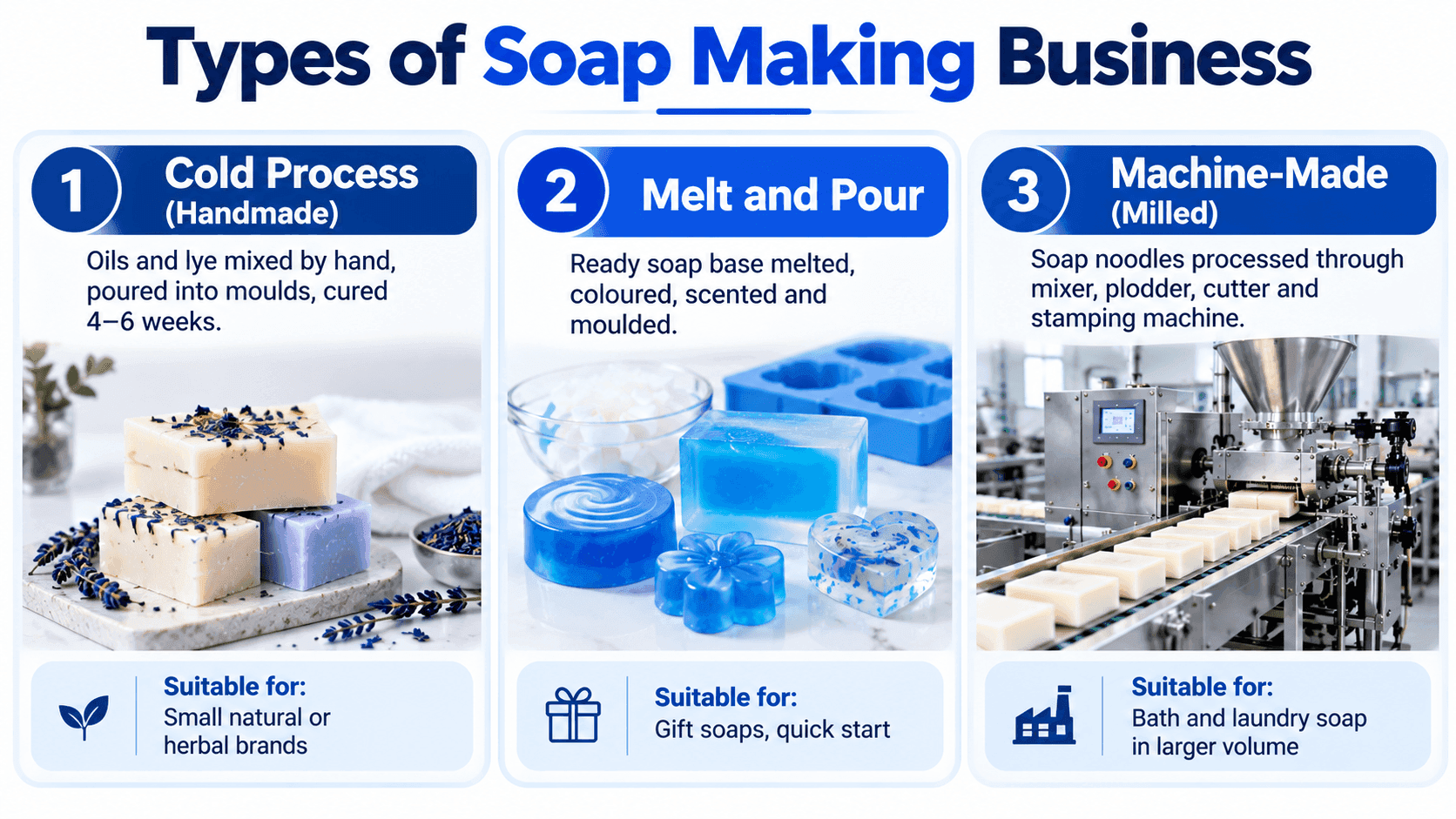
| Type | How It Works | Suitable For |
|---|---|---|
| Cold-process handmade soap | Oils and an alkali are mixed, poured into moulds, and allowed to cure for several weeks. | Small handmade or natural-soap brands |
| Melt-and-pour soap | A ready-made soap base is melted, customised, and poured into moulds. | Decorative soaps, gifts, and small product ranges |
| Machine-made soap | Soap materials or noodles are processed using industrial equipment. | Commercial production and larger volumes |
This method involves mixing oils with an alkali solution, pouring the mixture into moulds and allowing the soap to cure. Curing commonly takes several weeks, depending on the formulation and process.
It may suit entrepreneurs who want to build a small, specialised brand. Proper formulation, safe handling procedures, quality control and licensing are important.
In this method, a ready-made soap base is melted and customised with permitted colours, fragrances and other ingredients before being poured into moulds.
It can be useful for decorative soaps, gift products and small product ranges. Confirm the applicable regulatory requirements for your intended commercial activity.
Machine-based production is suitable for businesses planning to manufacture soap at a larger scale. Depending on the process, equipment may include mixers, mills, plodders, cutters, stamping machines and packaging machines.
The right machinery depends on the product type, production capacity, available space and budget.
There are two possible approaches to manufacturing, subject to approval under the applicable rules.
Own manufacturing unit: You arrange suitable premises, equipment, qualified technical personnel and the required manufacturing licence.
Loan-licence arrangement: You apply to manufacture through an eligible, already licensed facility under the applicable loan-licence framework.
A loan-licence arrangement may reduce the initial investment in factory infrastructure. However, it is not an automatic exemption from licensing requirements. Confirm the arrangement and required approvals with the relevant licensing authority.
The cost of soap making machinery varies according to capacity, automation, construction material, manufacturer and after-sales support.
Handmade soap production may require only basic tools. A larger manufacturing unit may need several machines to handle mixing, refining, shaping, cutting and packaging.
| Machine | Use | Indicative Price |
|---|---|---|
| Soap Mixer (Sigma or Screw Type) | Mixes soap material with colour and fragrance | ₹75,000 onwards |
| Triple Roller Mill | Refines and blends the soap mass | ₹75,000 onwards |
| Plodder (Simplex or Duplex) | Forms soap into a continuous bar | ₹65,000–₹6 lakh |
| Soap Cutting Machine | Cuts bars to the required size | Obtain supplier quotation |
| Soap Stamping Machine | Creates the shape or brand impression | Obtain supplier quotation |
| Packing Machine | Wraps or packs finished soap | Obtain supplier quotation |
Note: These are indicative planning figures, not confirmed quotations. Verify current prices with suppliers. GST, transport, installation and accessories may cost extra.
Before purchasing equipment, compare:
Production capacity per hour or per day.
Power consumption and electricity requirements.
Construction material and suitability for your product.
Warranty and availability of spare parts.
Installation, operator training and service support.
Total delivered cost, including taxes and transportation.
Request quotations from multiple suppliers and compare machines with similar specifications rather than choosing only by price.
The registrations you need depend on your business structure, location, manufacturing process and product category.
For products regulated as cosmetics, the Cosmetics Rules, 2020 provide for the relevant manufacturing-licence process.
The forms generally include:
Form COS-5: Application for a cosmetic manufacturing licence.
Form COS-7: Good Manufacturing Practices self-declaration, where applicable.
Form COS-8: Cosmetic manufacturing licence.
Form COS-6: Application for a loan licence.
Form COS-9: Loan licence.
Depending on your business and local requirements, you may also need:
Udyam registration: MSME registration, subject to eligibility.
GST registration: Tax registration when applicable.
Trade licence: Local municipal or business permission, where required.
Legal Metrology compliance: Packaged-commodity declarations and applicable registration requirements.
Pollution Control Board consent: Requirements based on the unit's category and state rules.
Fire NOC: Fire approval where required.
Trademark registration: Protection for your brand name and logo.
Your product packaging must comply with the applicable cosmetics and packaged-commodity rules.
Depending on the product and rules applicable to it, the label may need to include:
Product name and intended use.
Ingredient information.
Net weight.
Maximum Retail Price (MRP).
Batch or lot identification.
Manufacturer's name and address.
Manufacturing licence details, where required.
Manufacturing and expiry or use-before details, as applicable.
Other declarations required by the applicable regulations.
BIS requirements can change through government notifications and Quality Control Orders. Check the current BIS requirements and any applicable Quality Control Order for your specific product before starting manufacturing.
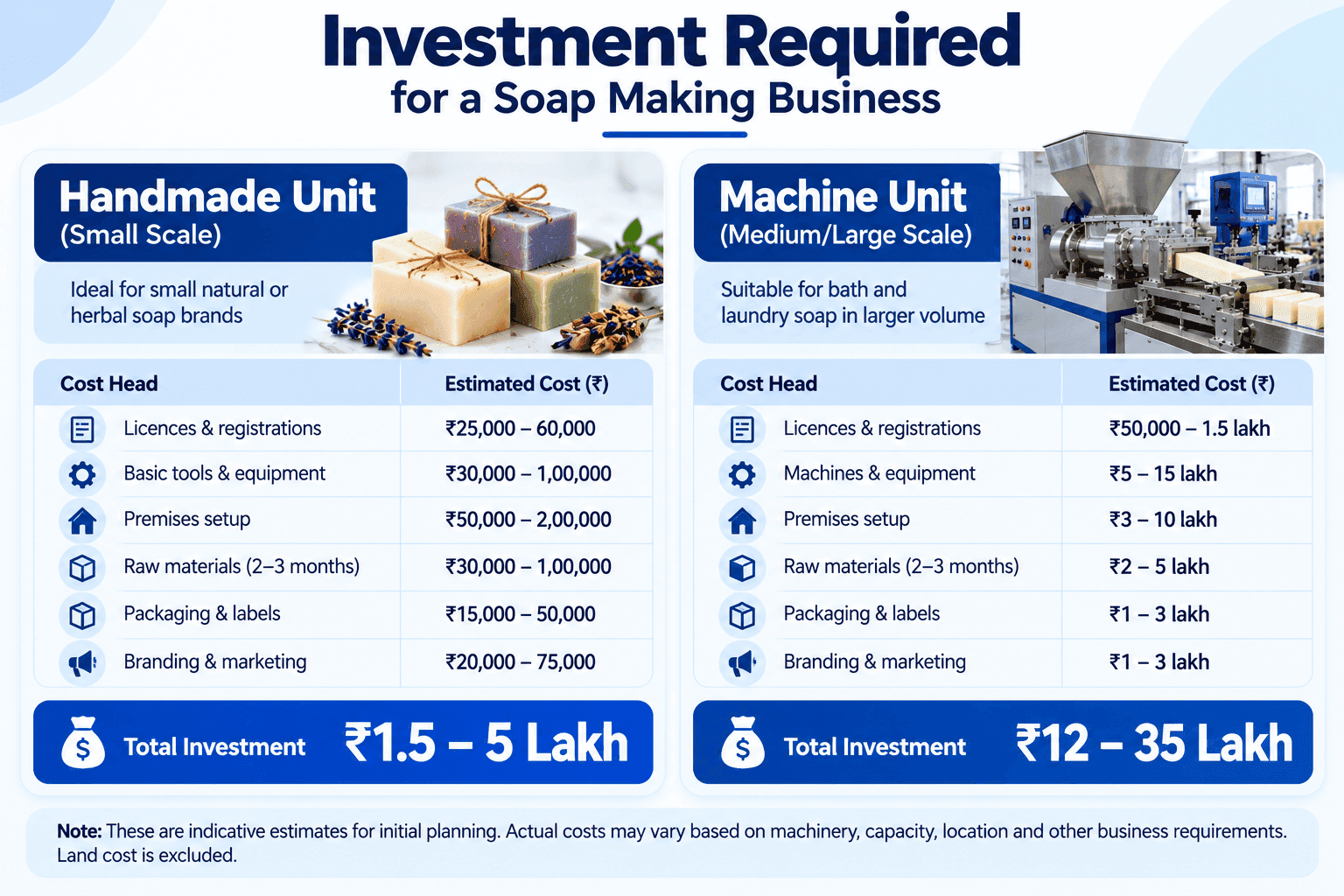
The total investment depends on whether you choose handmade production or a machine-based manufacturing unit.
| Cost Head | Handmade Unit | Machine-Based Unit |
|---|---|---|
| Licences and Registrations | ₹25,000–₹60,000 | ₹50,000–₹1.5 lakh |
| Machines and Tools | ₹30,000–₹1 lakh | ₹5–15 lakh |
| Premises Setup | ₹50,000–₹2 lakh | ₹3–10 lakh |
| Raw Materials for 2–3 Months | ₹30,000–₹1 lakh | ₹2–5 lakh |
| Packaging and Labels | ₹15,000–₹50,000 | ₹1–3 lakh |
| Branding and Marketing | ₹20,000–₹75,000 | ₹1–3 lakh |
| Approximate Total | ₹1.5–5 lakh | ₹12–35 lakh |
Note: These figures are indicative estimates for initial planning. They are not fixed market rates or verified quotations. Land costs are excluded, and the actual budget may vary.
Apart from the initial setup, plan for recurring expenses such as:
→ Labour wages and machine operators’ salaries
→ Electricity and water expenses
→ Raw material replenishment
→ Product testing and quality control
→ Packaging and printing costs
→ Transport and distribution expenses
→ Machine maintenance and spare parts
→ Rent and other overheads
→ Working capital to cover expenses until sales generate sufficient cash flow
Decide whether you want to manufacture bath soap, laundry soap, handmade soap or another type of cleansing product.
Your choice will affect the formulation, machinery, production process, packaging and target market.
Before investing in machinery, speak to local retailers, wholesalers, distributors and potential customers.
Research which products are already selling in your target area, the price range customers are willing to pay, competitors' packaging and product sizes, whether retailers accept new brands, and expected order quantities.
This research will help you select an appropriate production capacity.
Estimate your setup cost, monthly operating expenses, product cost, selling price and expected sales.
Include machinery, raw materials, labour, packaging, transportation, marketing and working capital in your calculations.
Avoid estimating profit from selling price alone. Calculate the complete cost of producing and delivering each unit.
Choose a suitable business structure, such as a proprietorship, partnership, LLP or company.
Complete the registrations that apply to your business, including Udyam and GST where applicable.
Choose premises that can accommodate your production process, storage, packing and finished products.
The premises must meet the applicable licensing, hygiene, safety and manufacturing requirements. Confirm these requirements before signing a long-term lease or spending heavily on renovation.
Choose equipment according to your product formulation and target production volume.
Compare machine specifications, warranty, spare-parts availability and service support. Source raw materials from reliable suppliers and maintain records of material quality.
Prepare the documents required by your State Licensing Authority and follow the applicable application process.
Do not begin commercial manufacturing or sale until the required approvals are in place.
Prepare labels that comply with the applicable cosmetics and packaged-commodity requirements.
Check ingredient information, batch identification, net weight, MRP and other required declarations before ordering packaging in bulk.
Run small batches to evaluate product consistency, quality and packaging performance.
Arrange appropriate product testing and maintain production and quality records. Confirm that the product is suitable for sale before increasing output.
Start with a manageable production volume and focus on finding repeat customers.
Once you understand demand, production costs and customer feedback, you can gradually expand distribution and production capacity.
- PMEGP: Eligible new manufacturing units may get a bank loan with a 15–35% subsidy, subject to scheme rules. Manufacturing project cost can be up to ₹50 lakh.
- PM Mudra Yojana: Eligible small businesses can apply for business loans through participating banks and lenders.
- State Government Schemes: Check available MSME subsidies and schemes at your local District Industries Centre (DIC). Note: Loan and subsidy approval depends on eligibility, documents and bank approval.
A Detailed Project Report (DPR) explains your proposed business, machinery, project cost, working capital, expected sales and repayment plan.
Banks and scheme authorities may require a DPR when assessing a funding application. Prepare realistic projections and support them with supplier quotations and market research.
Loan approval and subsidy benefits are subject to eligibility, scheme rules and lender approval.
After completing the applicable licensing and compliance requirements, you can explore different sales channels.
Approach kirana stores, general stores, cosmetic shops and other retailers. Offer clear product information and consistent quality.
Wholesalers may help you reach multiple retail outlets. Discuss minimum order quantities, margins, payment terms and delivery arrangements before finalising a deal.
You may explore marketplaces such as Amazon, Flipkart and Meesho, subject to their seller policies and applicable product requirements.
Include platform commissions, shipping charges, packaging and return-related costs when calculating your selling price.
A website, Instagram page and WhatsApp Business profile can help you showcase products, share product information and communicate with potential customers.
Use clear product photographs, accurate descriptions and transparent pricing.
Depending on your product and business model, you may approach hotels, gift shops, corporate gifting providers and other bulk buyers.
Confirm product specifications, packaging requirements, order volumes and payment terms before accepting large orders.
Do not assume that handmade or home-based production is automatically exempt from licensing. Confirm the applicable requirements before commercial manufacture and sale.
Avoid claims such as "cures skin disease" unless your product is legally authorised for that purpose. Use accurate product descriptions that match the product's approved category and intended use.
Your actual investment includes raw materials, packaging, labour, utilities, transport, compliance and working capital. Budget for the complete operation.
Incorrect or incomplete labels can create compliance problems. Review your packaging against the applicable regulations before printing in bulk.
Compare capacity, quality, energy use, warranty, spare parts and service support. A low purchase price may not mean a lower total operating cost.
Large production volumes can tie up money in unsold stock. Test demand and establish sales channels before expanding production.
Consistent quality is important for customer trust and repeat purchases. Use appropriate formulations, reliable raw materials, quality checks and proper production records.

Starting a manufacturing business involves several decisions, from choosing equipment to planning the investment and preparing for production.
StartupHyper supports entrepreneurs and small manufacturers with guidance in areas such as:
- Machine selection: Identify machinery suited to your proposed product and production capacity.
Business planning: Estimate setup costs and prepare a practical manufacturing plan.
Project report (DPR): Get support with preparing project documentation for a funding application.
Loan and scheme guidance: Understand potential financing routes, including applicable government schemes.
Plant setup support: Plan equipment placement and production requirements.
Branding and marketing: Prepare product packaging and explore suitable sales channels.
The support and availability of specific services should be confirmed with StartupHyper before proceeding.
Ready to explore your manufacturing business idea? Contact StartupHyper to discuss your requirements.
Soap products regulated as cosmetics generally require the applicable manufacturing licence before commercial manufacture and sale. Confirm the requirements with your State Licensing Authority, including for small-scale and home-based production.
The applicable fee depends on the licence category and current rules. Verify the latest government fee schedule with the relevant State Licensing Authority before preparing your budget. Consultant and setup costs, if any, are separate.
An indicative budget for a handmade unit may be around ₹1.5–5 lakh, while a machine-based unit may require approximately ₹12–35 lakh, excluding land. Actual costs depend on capacity, machinery, location and working capital.
Possibly, but a home-based setup is not automatically exempt from applicable licensing and manufacturing requirements. Confirm whether your premises can meet the requirements for the product and licence category you intend to pursue.
A loan-licence arrangement may be an option where permitted. You must meet the applicable requirements and obtain the required approval for the arrangement.
BIS requirements depend on the current standards and applicable Quality Control Orders. Check the latest official requirements for your specific product before manufacturing.
Eligible entrepreneurs may explore PMEGP, PM Mudra Yojana and applicable state schemes. Approval depends on eligibility, the project report, scheme rules and lender assessment.
Profit depends on raw material costs, production efficiency, packaging, selling price, competition, distribution expenses and sales volume. Calculate the complete cost per bar and validate customer demand before investing.
Depending on the process and capacity, a machine-based unit may need a mixer, triple roller mill, plodder, cutting machine, stamping machine and packing machine. The exact equipment depends on your formulation and production method.
Start by researching local retailers, wholesalers and potential bulk buyers. You can also explore online marketplaces, your own website and social media, subject to the applicable product and seller requirements.
→Candle Making Business in Bihar 2026
→Diwali Business Ideas 2026: 10 Products to Make & Sell
→Pickle Manufacturing Business: Cost, Process & Investment
→How to Start Popcorn Manufacturing Business (2026 Guide)
वेबसाइट: https://www.startuphyper.com/
कॉल या व्हाट्सऐप: 9472093913
ईमेल: info@startuphyper.com
मशीनरी मार्केटप्लेस: https://www.machinehai.com/
Stay updated with the latest tips, trends, and best practices in factory setup and machinery procurement—subscribe to the StartupHyper newsletter!
No spam, we promise. Your inbox is safe with us—only valuable insights.