Read the full article to gain deeper insights and comprehensive information.

Jul 23, 2026
0
Learn how to start a Tomato Ketchup Manufacturing Business in India. Know the investment, machinery, manufacturing process, licenses, profit margin, and complete setup guide.
→ To Read our full guide in Hindi: Click Here
The demand for processed food products has grown rapidly in India over the last few years, and Tomato Ketchup has become one of the most widely used condiments in homes, restaurants, hotels, cafés, fast-food outlets, and cloud kitchens.
With changing food habits and the increasing popularity of snacks like burgers, sandwiches, pizzas, french fries, and momos, the consumption of tomato ketchup continues to rise. This creates an excellent opportunity for entrepreneurs to enter the Tomato Ketchup Manufacturing Business.
Another advantage of this business is that tomato ketchup has a longer shelf life than fresh tomatoes. Manufacturers can also build their own brand and supply products to retailers, supermarkets, wholesalers, restaurants, schools, and institutional buyers.
A Tomato Ketchup Manufacturing Business involves processing fresh tomatoes into ketchup by adding ingredients such as sugar, salt, vinegar, spices, and approved food additives. The finished product is then packed in bottles, pouches, or sachets and sold in the market.
Modern manufacturing plants use food processing machinery to automate washing, pulping, cooking, mixing, filling, and packaging. This ensures consistent product quality, improves production efficiency, and reduces manual labor.
Depending on your investment, you can start with a small-scale manufacturing unit or establish a fully automated Tomato Ketchup Manufacturing Plant for commercial production.
Tomato ketchup is one of the fastest-moving products in the food processing industry because it is consumed across different customer segments throughout the year.
Some of the major buyers include:
Apart from selling under your own brand, you can also manufacture tomato ketchup for private labels, institutional buyers, and restaurant chains.
The quality of your finished product depends largely on the quality of raw materials used during production.
Some of the major raw materials include:
The quality of tomatoes directly affects the color, taste, consistency, and shelf life of the ketchup. Therefore, sourcing fresh tomatoes from reliable suppliers is essential.
With attractive packaging and competitive pricing, entrepreneurs can expand from local markets to regional and national distribution.
The investment required depends on factors such as production capacity, automation level, machinery, packaging type, and factory size.
Below is a general estimate.
| Business Type | Estimated Investment |
|---|---|
| Small-Scale Manufacturing Unit | ₹8–20 Lakhs |
| Semi-Automatic Plant | ₹20–50 Lakhs |
| Fully Automatic Manufacturing Plant | ₹50 Lakhs–₹2 Crore+ |
If you already own a suitable building, your initial setup cost can be significantly reduced.
The overall project cost varies depending on several important factors.
Higher production capacity requires larger processing equipment, more storage space, and higher working capital.
A fully automatic production line requires higher initial investment but offers faster production, better consistency, and lower labor costs.
High-quality food processing machines provide better efficiency, improved product consistency, and lower maintenance costs over the long term.
The cost of production also depends on whether you pack ketchup in:
Different packaging options require different filling and sealing machines.
If you're planning to launch your own brand, you'll also need to invest in:
These costs should be included while preparing your Tomato Ketchup Business Plan.
Tomato ketchup is a high-demand FMCG product with year-round consumption. Since it is used in households as well as commercial food businesses, manufacturers can build multiple sales channels and generate repeat orders.
Some of the key advantages of this business include:
The quality and production capacity of your Tomato Ketchup Manufacturing Business largely depend on the machinery you choose. Investing in the right equipment helps improve production efficiency, maintain consistent product quality, reduce wastage, and comply with food safety standards.
Depending on your budget and production capacity, you can set up a Semi-Automatic or Fully Automatic Tomato Ketchup Manufacturing Plant.
Below are the essential machines required to manufacture tomato ketchup.
The manufacturing process begins with washing fresh tomatoes. A Tomato Washing Machine removes dust, mud, pesticides, and other impurities before processing.
Proper washing ensures better product quality and helps maintain food hygiene standards.
After washing, tomatoes are fed into a Tomato Crusher or Pulper Machine, where they are crushed into pulp.
The machine separates seeds, peels, and unwanted particles, producing a smooth tomato pulp that is used for ketchup manufacturing.
The tomato pulp is transferred to a Steam Jacketed Kettle, where it is cooked at a controlled temperature.
During this stage, ingredients such as sugar, salt, vinegar, spices, and approved food additives are mixed with the pulp to achieve the desired taste, consistency, and shelf life.
A steam jacketed kettle ensures uniform heating and prevents the product from burning.
After cooking, the ketchup is temporarily stored in Stainless Steel Storage Tanks before filling and packaging.
Food-grade storage tanks help maintain hygiene and preserve product quality.
The prepared ketchup is filled into bottles, jars, pouches, or sachets using a Bottle Filling Machine.
Automatic filling machines improve accuracy, reduce product wastage, and increase production speed.
Once filled, the bottles are sealed using a Bottle Capping Machine to prevent leakage and contamination.
Proper sealing also increases the shelf life of the product.
A Labeling Machine applies product labels containing:
Professional labeling improves product presentation and helps build brand identity.
A Batch Coding Machine prints important information such as:
This information is mandatory for packaged food products and helps maintain product traceability.
For wholesale distribution, many manufacturers use a Shrink Wrapping Machine to bundle multiple bottles together.
This protects products during transportation and gives them a professional appearance.
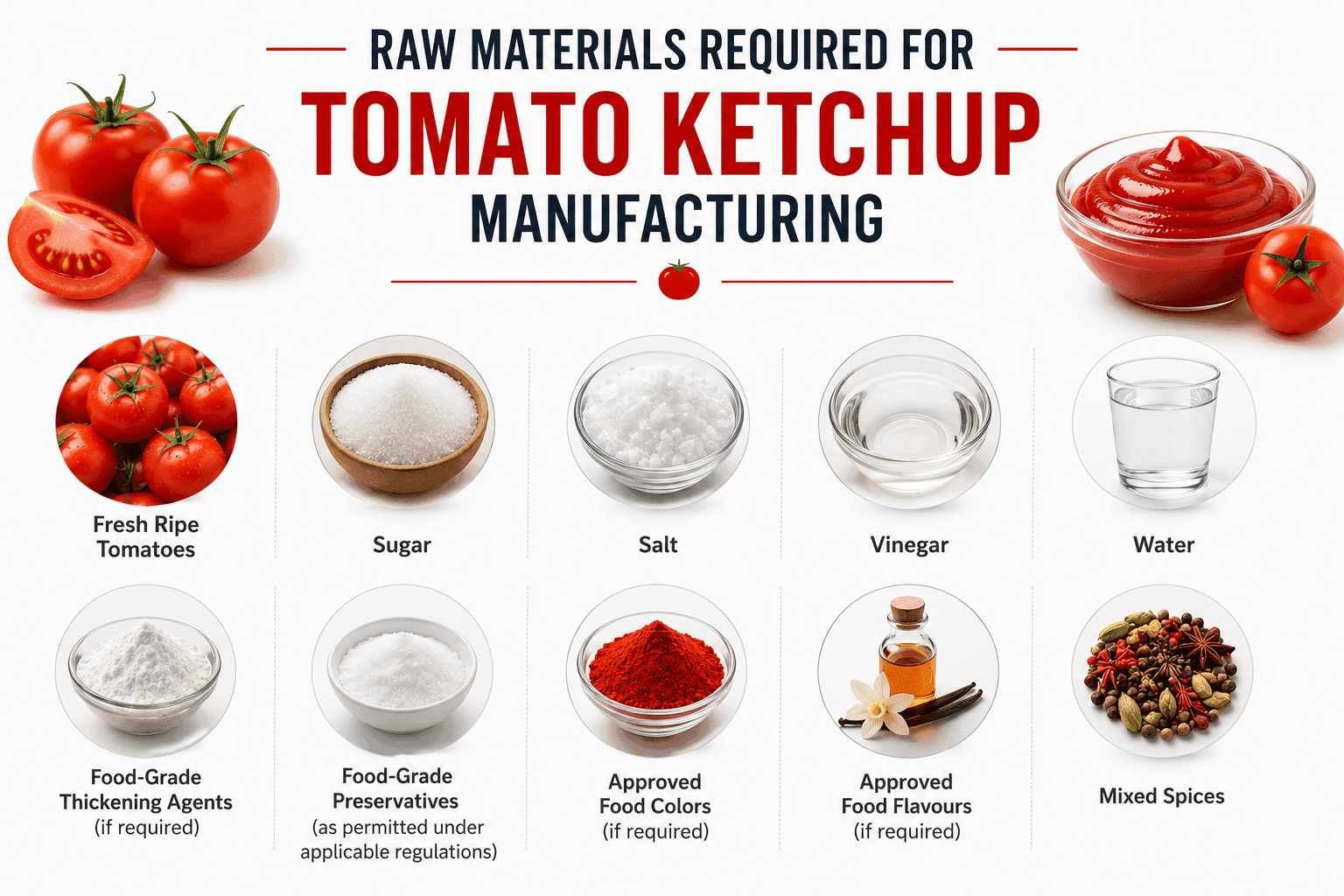
The quality of your finished product depends largely on the quality of raw materials used during production.
Some of the major raw materials include:
The quality of tomatoes directly affects the color, taste, consistency, and shelf life of the ketchup. Therefore, sourcing fresh tomatoes from reliable suppliers is essential.
With attractive packaging and competitive pricing, entrepreneurs can expand from local markets to regional and national distribution.
The investment required depends on factors such as production capacity, automation level, machinery, packaging type, and factory size.
Below is a general estimate.
| Business Type | Estimated Investment |
|---|---|
| Small-Scale Manufacturing Unit | ₹8–20 Lakhs |
| Semi-Automatic Plant | ₹20–50 Lakhs |
| Fully Automatic Manufacturing Plant | ₹50 Lakhs–₹2 Crore+ |
If you already own a suitable building, your initial setup cost can be significantly reduced.
The overall project cost varies depending on several important factors.
Higher production capacity requires larger processing equipment, more storage space, and higher working capital.
A fully automatic production line requires higher initial investment but offers faster production, better consistency, and lower labor costs.
High-quality food processing machines provide better efficiency, improved product consistency, and lower maintenance costs over the long term.
The cost of production also depends on whether you pack ketchup in:
Different packaging options require different filling and sealing machines.
If you're planning to launch your own brand, you'll also need to invest in:
These costs should be included while preparing your Tomato Ketchup Business Plan.
Tomato ketchup is a high-demand FMCG product with year-round consumption. Since it is used in households as well as commercial food businesses, manufacturers can build multiple sales channels and generate repeat orders.
Some of the key advantages of this business include:
The quality and production capacity of your Tomato Ketchup Manufacturing Business largely depend on the machinery you choose. Investing in the right equipment helps improve production efficiency, maintain consistent product quality, reduce wastage, and comply with food safety standards.
Depending on your budget and production capacity, you can set up a Semi-Automatic or Fully Automatic Tomato Ketchup Manufacturing Plant.
Below are the essential machines required to manufacture tomato ketchup.
The manufacturing process begins with washing fresh tomatoes. A Tomato Washing Machine removes dust, mud, pesticides, and other impurities before processing.
Proper washing ensures better product quality and helps maintain food hygiene standards.
After washing, tomatoes are fed into a Tomato Crusher or Pulper Machine, where they are crushed into pulp.
The machine separates seeds, peels, and unwanted particles, producing a smooth tomato pulp that is used for ketchup manufacturing.
The tomato pulp is transferred to a Steam Jacketed Kettle, where it is cooked at a controlled temperature.
During this stage, ingredients such as sugar, salt, vinegar, spices, and approved food additives are mixed with the pulp to achieve the desired taste, consistency, and shelf life.
A steam jacketed kettle ensures uniform heating and prevents the product from burning.
After cooking, the ketchup is temporarily stored in Stainless Steel Storage Tanks before filling and packaging.
Food-grade storage tanks help maintain hygiene and preserve product quality.
The prepared ketchup is filled into bottles, jars, pouches, or sachets using a Bottle Filling Machine.
Automatic filling machines improve accuracy, reduce product wastage, and increase production speed.
Once filled, the bottles are sealed using a Bottle Capping Machine to prevent leakage and contamination.
Proper sealing also increases the shelf life of the product.
A Labeling Machine applies product labels containing:
Professional labeling improves product presentation and helps build brand identity.
A Batch Coding Machine prints important information such as:
This information is mandatory for packaged food products and helps maintain product traceability.
For wholesale distribution, many manufacturers use a Shrink Wrapping Machine to bundle multiple bottles together.
This protects products during transportation and gives them a professional appearance.
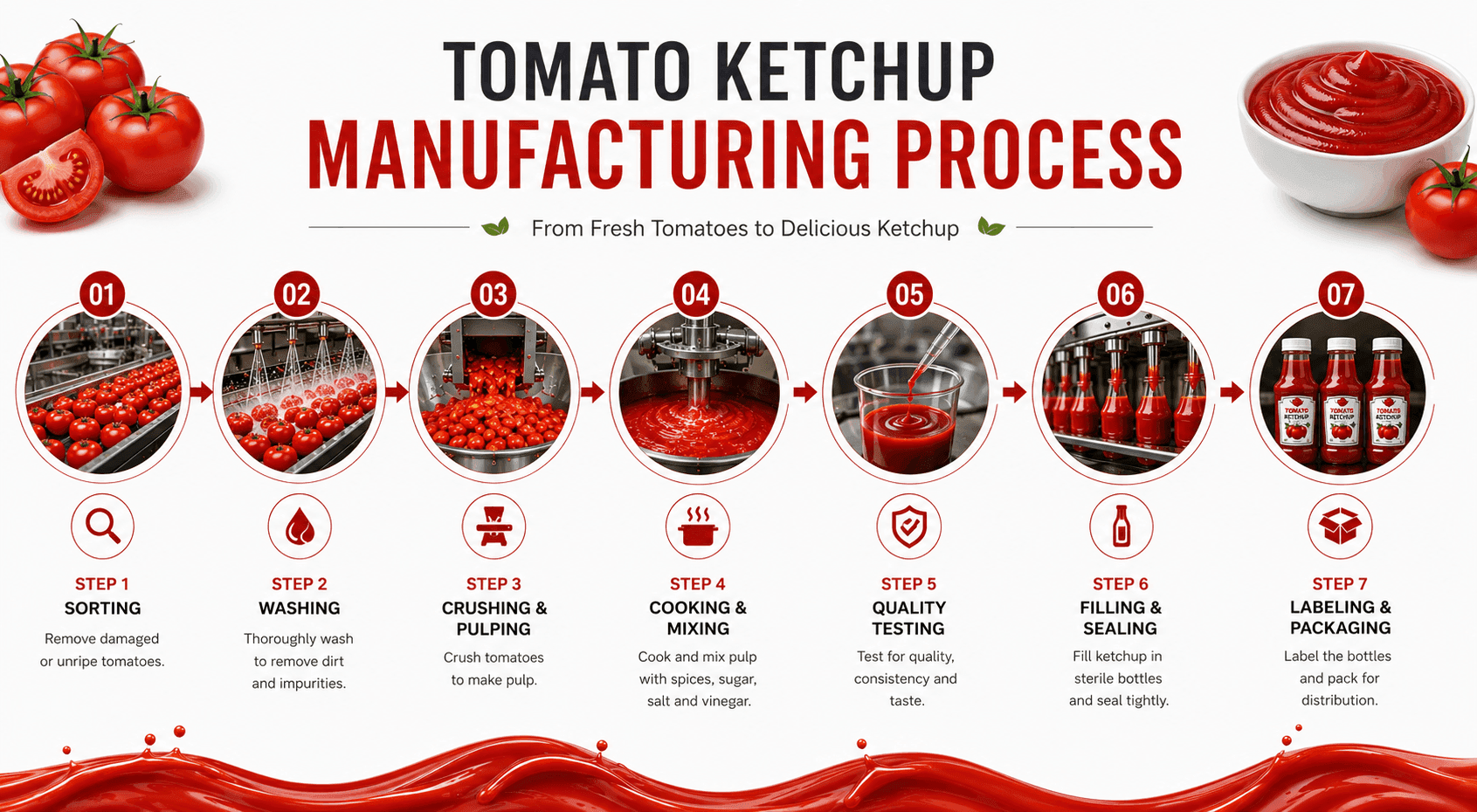
A standard Tomato Ketchup Manufacturing Process consists of several stages to ensure consistent taste, texture, and quality.
Fresh, ripe tomatoes are selected, while damaged or spoiled tomatoes are removed.
The tomatoes are thoroughly washed to remove dirt, dust, and other impurities.
The cleaned tomatoes are crushed and passed through a Pulper Machine to separate seeds and peels from the pulp.
The tomato pulp is cooked in a Steam Jacketed Kettle. Sugar, salt, vinegar, spices, and other approved ingredients are added according to the recipe.
The mixture is continuously stirred until the desired consistency is achieved.
Before packaging, the ketchup is tested for:
Quality testing helps maintain product standards and customer satisfaction.
The finished ketchup is filled into bottles, jars, pouches, or sachets using filling machines and then sealed properly.
Finally, labels are applied, batch details are printed, and the products are packed into cartons for storage and transportation.
The land requirement depends on the production capacity and level of automation.
| Business Type | Approximate Area Required |
|---|---|
| Small Manufacturing Unit | 1,000–1,500 sq. ft. |
| Semi-Automatic Plant | 2,000–4,000 sq. ft. |
| Fully Automatic Plant | 5,000 sq. ft. or more |
A well-planned layout improves productivity and ensures smooth workflow.
Before starting commercial production, you need to obtain the necessary registrations and approvals.
You can register your business as:
Since tomato ketchup is a food product, obtaining an FSSAI License is mandatory for manufacturing and selling.
Registering under MSME allows businesses to access government schemes, easier loan approvals, and various financial benefits.
GST registration may be required depending on your turnover and business operations.
A Trade License issued by the local municipal authority may be required to operate your manufacturing unit.
Larger manufacturing units may require a Factory License as per applicable state regulations.
Depending on the production scale and state regulations, you may need approval from the State Pollution Control Board.
Always verify the latest compliance requirements applicable in your state before starting operations.
Several government schemes support entrepreneurs in setting up food processing businesses.
Eligible entrepreneurs can apply for financial assistance under PMEGP to start a new manufacturing business.
The Pradhan Mantri Formalisation of Micro Food Processing Enterprises (PMFME) scheme supports micro food processing units by providing financial assistance, technical support, and skill development.
Tomato ketchup manufacturing units may benefit if they meet the eligibility criteria.
MSME registration offers several advantages, including:
Starting a Tomato Ketchup Manufacturing Business becomes easier when you follow a structured plan.
Conduct market research and identify your target customers.
Prepare a detailed Tomato Ketchup Business Plan, including investment, machinery, production capacity, and marketing strategy.
Select a suitable location with proper electricity, water supply, and transportation facilities.
Complete all required registrations and obtain the necessary licenses.
Purchase high-quality Tomato Ketchup Manufacturing Machines based on your production goals.
Install the machinery, recruit trained staff, and conduct trial production.
Launch your brand and start supplying products to retailers, supermarkets, distributors, restaurants, hotels, and online marketplaces.
One of the biggest advantages of starting a Tomato Ketchup Manufacturing Business is the growing demand for packaged food products in India. Tomato ketchup is consumed throughout the year by households, restaurants, hotels, cafés, fast-food chains, cloud kitchens, and catering businesses, making it a business with consistent market demand.
Your profit depends on several factors, including:
A well-managed manufacturing unit with efficient operations and strong distribution can generally achieve a net profit margin of around 15% to 30%.
The monthly income depends on your production capacity, sales volume, and customer base.
Below is a general estimate.
| Business Size | Estimated Monthly Revenue |
|---|---|
| Small Manufacturing Unit | ₹5–15 Lakhs |
| Semi-Automatic Plant | ₹15–40 Lakhs |
| Fully Automatic Plant | ₹40 Lakhs+ |
Note: These figures are indicative estimates. Actual revenue and profit depend on production capacity, raw material prices, operating costs, market demand, and selling price.
Growing a profitable ketchup business requires more than just manufacturing. Product quality, branding, and efficient operations play an equally important role.
Fresh and ripe tomatoes improve the color, taste, texture, and consistency of ketchup. Better raw materials also reduce wastage during production.
Modern Tomato Ketchup Manufacturing Machines help maintain product consistency, increase production speed, reduce labor costs, and minimize product loss.
Packaging plays a major role in customer buying decisions.
Offer products in different pack sizes such as:
Different packaging options allow you to target households, restaurants, and institutional buyers.
Launching your own brand helps improve customer loyalty and allows you to earn better profit margins compared to contract manufacturing.
Invest in:
After establishing your ketchup business, you can introduce additional products such as:
This helps increase sales and attract more distributors.
Don't depend on a single customer segment.
Sell your products through:
A diversified customer base helps ensure stable revenue throughout the year.
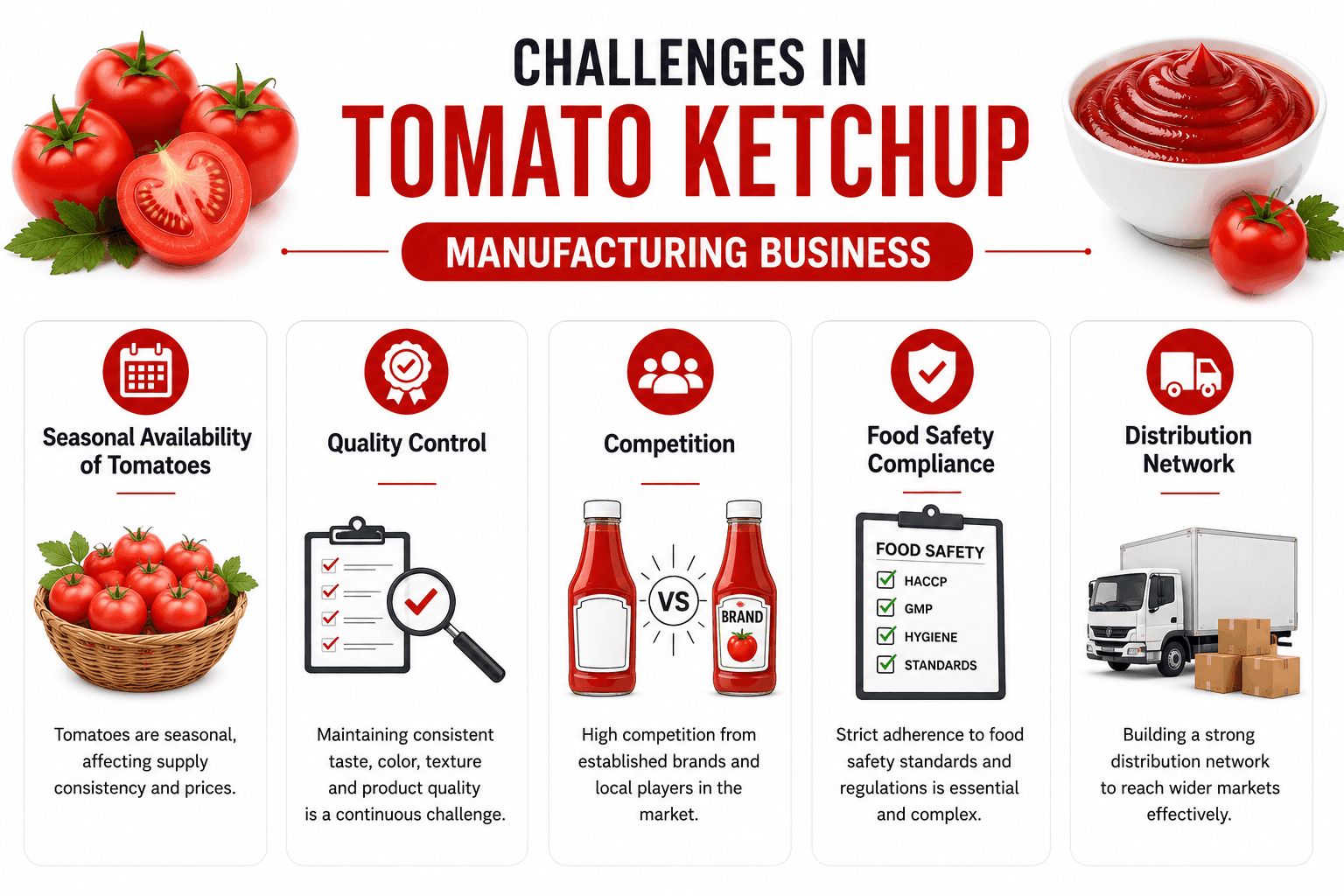
Like every food processing business, Tomato Ketchup Manufacturing also has certain challenges.
Tomato prices can fluctuate depending on the season. Proper sourcing and inventory planning help manage raw material costs.
Maintaining the same taste, color, and consistency in every batch is essential for customer satisfaction and brand reputation.
The market includes several established national and regional brands. New businesses should focus on quality, competitive pricing, and strong branding to stand out.
Manufacturers must follow FSSAI guidelines, maintain hygiene, and implement proper quality control processes to ensure product safety.
A strong distribution network is essential to reach retailers, supermarkets, restaurants, and institutional buyers efficiently.
A good product alone is not enough. Effective marketing is equally important.
Here are some proven strategies:

Setting up a Tomato Ketchup Manufacturing Business requires careful planning, the right machinery, and expert guidance. At StartupHyper, we help entrepreneurs choose the best equipment and create a strong foundation for their manufacturing business.
▶ Expert consultation for setting up Tomato Ketchup Manufacturing Units.
▶ Guidance in selecting the right Tomato Processing and Packaging Machinery.
▶ Machinery options based on your production capacity and budget.
▶ Support in comparing machines from trusted manufacturers.
▶ Assistance with complete project planning and factory setup.
▶ Competitive quotations with transparent pricing.
▶ End-to-end guidance from machine selection to installation.
Whether you're planning a Small-Scale Manufacturing Unit or a Fully Automatic Tomato Ketchup Manufacturing Plant, StartupHyper helps you choose the right machinery and business setup for long-term success.
Yes. Due to the growing demand from households, restaurants, hotels, and fast-food businesses, tomato ketchup manufacturing can be a profitable business when supported by quality products, efficient operations, and a strong distribution network.
The investment depends on the scale of the business. A small manufacturing unit may require around ₹8–20 lakhs, while a fully automatic plant can require ₹50 lakhs to ₹2 crore or more.
The major machines include:
Yes. You can begin with a small-scale manufacturing unit and gradually expand production as your customer base grows.
Generally, you'll need:
The shelf life depends on the formulation, packaging, and storage conditions. Products manufactured under proper food safety standards and packed correctly generally have a longer shelf life.
Major buyers include:
Yes. Many entrepreneurs start their own tomato ketchup brand and sell through retail stores, distributors, online marketplaces, and institutional buyers.
The Tomato Ketchup Manufacturing Business is a promising opportunity in India's growing food processing industry. With increasing demand from households, restaurants, cafés, and food service businesses, entrepreneurs can build a profitable venture by focusing on product quality, efficient production, and effective branding.
Success in this business depends on selecting the right machinery, sourcing quality raw materials, following food safety standards, and developing a strong distribution network. Starting with a well-prepared Tomato Ketchup Business Plan and choosing machinery that matches your production goals can help reduce operational challenges and improve long-term profitability.
If you're planning to start a Tomato Ketchup Manufacturing Business in India, StartupHyper can assist you with machinery selection, project planning, quotations, and expert guidance to help you build a successful food processing business.
📞Call / WhatsApp: 9472093913
📧Email: info@startuphyper.com
🌐 Website: www.startuphyper.com | www.machinehai.com
🏢 Branches: Patna | Gaya | Katihar | Saharsa
Stay updated with the latest tips, trends, and best practices in factory setup and machinery procurement—subscribe to the StartupHyper newsletter!
No spam, we promise. Your inbox is safe with us—only valuable insights.